Prepare before the first cast
Good fish handling starts before a fish bites. Put a landing net, pliers or a hook-removal tool, and any other essentials within easy reach. If you plan to take a photo, decide where your camera will go before you begin. A few moments of preparation can mean less time holding a fish out of the water.
Choose tackle suited to the fish you expect to encounter. Gear that is too light can make it difficult to bring a fish in without a prolonged struggle. Single hooks and barbless hooks, or hooks with flattened barbs, may make removal simpler in some situations. Check the rules for the lake and the species you may catch, since permitted gear and handling requirements vary.
Think about your landing spot, too. A stable place at the water’s edge makes it easier to release a fish without carrying it across rocks or sand. If you are fishing from a dock or boat, plan how you will reach the water safely. You do not need an elaborate setup; you need room to work calmly.
Land the fish with control
Once a fish is hooked, keep steady pressure and bring it in without unnecessary delay. The aim is not to rush so hard that the line breaks, but to avoid an extended fight when your gear allows a shorter one. Be especially attentive when the water feels unusually warm: fish may have a harder time recovering after exertion in such conditions.
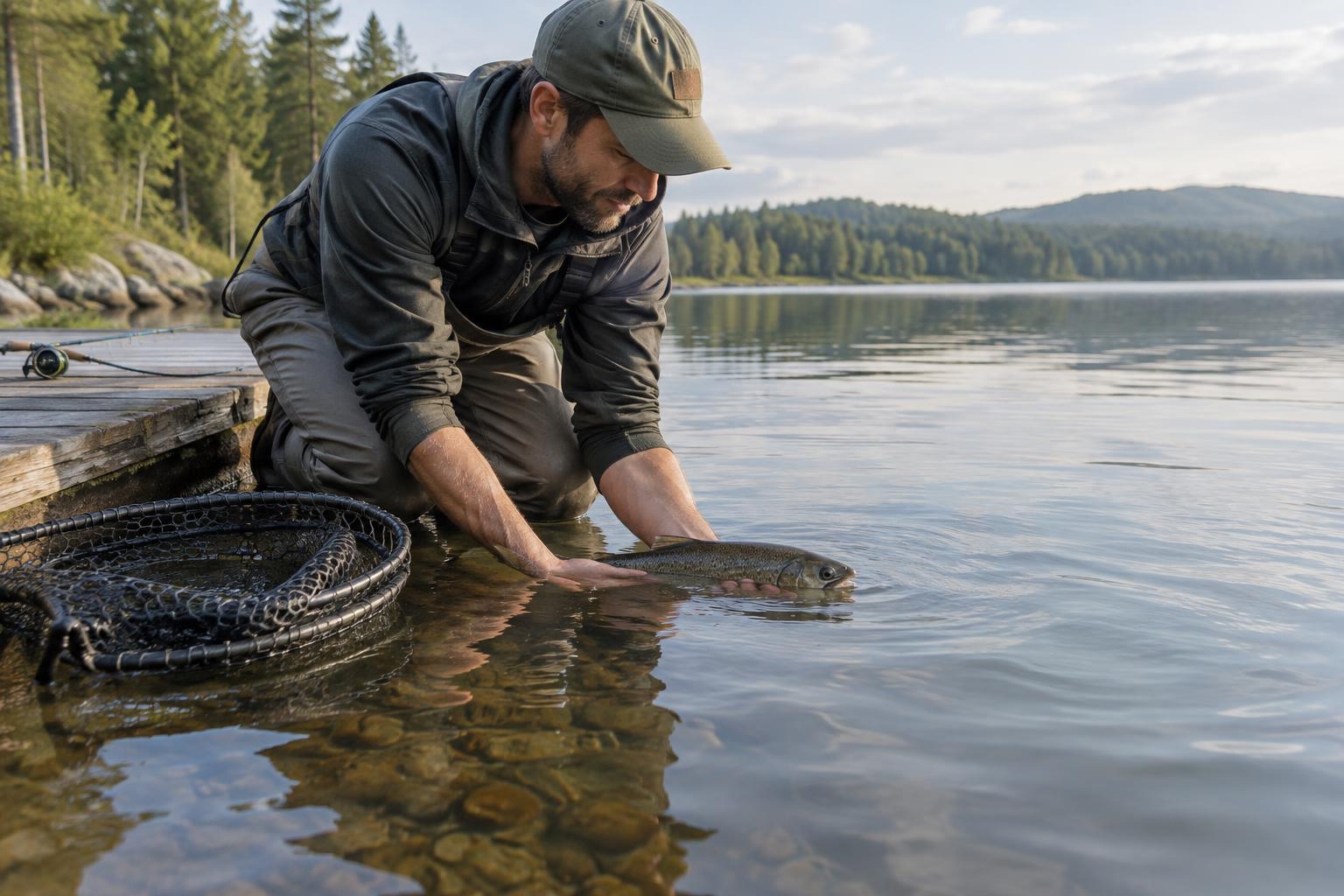
If you use a net, a soft, knotless mesh is a practical choice for many lake fish. Lead the fish into the net rather than scooping at it repeatedly. Keep the net in the water where possible while you get ready to remove the hook. Avoid dragging the fish onto a dry bank, dock, or boat deck, where it can thrash against a hard surface.
Some fish are small enough to handle without a net, while others are not. Whatever the size, avoid lifting a fish by the line or leaving it hanging from the hook. A controlled landing protects the fish and gives you a better chance to remove the hook without fumbling.
Handle gently and remove the hook
Wet your hands before touching a fish. Dry hands, towels, and rough surfaces can disturb the protective coating on its skin. Hold the fish securely but lightly, supporting its body rather than squeezing its belly. Keep fingers away from the gills and eyes. If a species has sharp spines or teeth, learn a safe hold before fishing for it.
Keep the fish close to the water while you work. Use pliers or a hook-removal tool to back the hook out along the path it entered, without pulling against the fish’s body. If the hook is difficult to reach or deeply embedded, do not prolong the struggle or force it free. The best response can depend on the hook and species; consult local fishery guidance for those situations.
A photograph is optional. If you want one, have the camera ready and take it quickly, ideally with the fish held low over the water. Skip repeated poses or passing the fish between people. When removal or a photograph is taking longer than expected, return the fish to the water while you regroup if you can do so safely.
Release with attention, not a toss
Lower the fish into the water, facing it into a gentle current if one is present. In still lake water, hold it upright and let water move naturally over its gills. Support it lightly until it is able to swim away on its own. Do not throw it from a height, push it back and forth aggressively, or release it into shallow water where it may strike the bottom.
Watch for a moment after release when visibility allows. A fish that remains on its side may need more time supported upright in the water. Even careful handling cannot guarantee that every fish will survive, which is why reducing the fight, handling time, and air exposure matters.
Let conditions shape the outing
Catch-and-release is not a single technique that fits every lake or season. Rules may differ by location, and some fisheries have specific requirements for certain species. Check local guidance before your trip, then follow it at the water. If fish are repeatedly swallowing hooks, consider changing your hook or bait setup rather than treating each difficult removal as unavoidable.
A relaxed lakeside outing also leaves room to change plans. If heat, rough conditions, or your landing spot make gentle handling difficult, take a break or choose another activity by the water. Being ready to put the rod down is part of treating the fish and the place with care.